Introduction: Why this movement still dazzles
If craft, color, and clean lines thrill you, Vienna Art Nouveau architecture delivers in spades. In this friendly guide, you’ll trace the city’s `Jugendstil` masterpieces—from the Secession Building’s shimmering dome to the Majolikahaus’s floral facade and Otto Wagner’s gold-ornamented Stadtbahn pavilions. You’ll get history in plain language, practical route tips, and design details to spot, so you can appreciate both the big statements and the subtle flourishes.
We’ll cover:
– The Secession Building’s symbolism and must-see interior
– The Majolikahaus and neighboring Medallion House on Linke Wienzeile
– Wagner’s Stadtbahn legacy, including the gilded Karlsplatz pavilions
– A smart one-day route, photo tips, and etiquette
How to read Vienna’s Jugendstil in context
From historicism to modern clarity
At the turn of the 20th century, young Viennese designers rebelled against ornate historic styles. They embraced clean geometry, stylized nature, and new materials. The result: a refined, functional beauty that still feels fresh.
– 1897: Artists and architects form the `Secession` movement.
– 1898: The Secession Building opens as a radical exhibition hall.
– 1894–1901: Otto Wagner oversees the Stadtbahn project, defining a modern urban aesthetic.
> “Something impractical cannot be beautiful.” — Otto Wagner
Wagner’s principle still guides good design today: beauty grows from function.
The people behind the facades
– Otto Wagner: Master of modern transport design; champion of rational, elegant structure.
– Joseph Maria Olbrich: Designed the Secession Building itself.
– Koloman Moser: Graphic genius whose motifs appear on reliefs and interiors.
– Gustav Klimt: Co-founder; his Beethoven Frieze remains a Secession highlight.
Materials and motifs to spot
Look for:
– Glazed ceramic tiles (washable and colorfast)
– Wrought and cast iron in crisp, repeating patterns
– Gilded details—sunflowers, laurel leaves, and abstract flora
– Flat ornament arranged on a strong grid
Architects aimed for `Gesamtkunstwerk`—a “total work of art” where architecture, graphics, furniture, and signage harmonize.
The Secession Building: A manifesto in marble and laurel
What to look for outside
Nicknamed the “Golden Cabbage,” the dome crowns a disciplined, white cube. According to the Secession, the lattice holds about 3,000 gilded laurel leaves and 700 berries—an exacting feat of metalwork. Above the entrance, read the motto: “Der Zeit ihre Kunst, der Kunst ihre Freiheit” (To every age its art, to every art its freedom).
Design-reading tips:
– Notice how flat floral ornament hugs the surface rather than protruding.
– The grid of the facade frames ornament like a picture plane.
– The dome’s airy filigree lightens the composition, preventing heaviness.
Inside: the Beethoven Frieze experience
Gustav Klimt’s monumental Beethoven Frieze (1902) stretches across three walls, interpreting Beethoven’s Ninth. Expect symbolic figures, gold accents, and a narrative that moves from human struggle to transcendent joy.
Practical notes:
– Interiors rotate with exhibitions; check the official Secession site for current shows and tickets.
– Average visit: 45–75 minutes if you linger with the frieze.
– Keep noise low; the space is a working gallery.
Photo tips and etiquette
– Natural light is best in late morning and mid-afternoon for the dome.
– Use a mild wide-angle for full-facade shots from across Friedrichstraße.
– Respect interior photography rules; they change with exhibitions.
– Common mistake: standing too close to the dome from the plaza; step back toward the Naschmarkt to fit it cleanly.
Mini case study: A focused design morning
A two-hour deep dive:
1. 30 minutes circling the exterior, noting grid vs. ornament.
2. 45 minutes inside with the Beethoven Frieze.
3. 45-minute stroll through the Naschmarkt for reflection and notes.
Add-on: Pair with the Architecture Center Vienna nearby for broader context.
Majolikahaus and the Medallion House: Floral facades on Linke Wienzeile
A facade that blooms year-round
Otto Wagner’s Majolikahaus (1898–99) at Linke Wienzeile 40 bursts with stylized flowers rendered in glazed ceramic “majolica” tiles, often attributed to designer Alois Ludwig. The tiles are not just pretty—they’re practical. Their glazed surface is durable and washable, ideal for a smoky, bustling city of the era.
Look closely for:
– Repeating floral stencils that form a wallpaper-like field
– Subtle color shifts in pinks, greens, and blues that model the blossoms
– Slim iron balconies with linear rhythm, balancing the floral abundance
Don’t miss its neighbor
Next door at Linke Wienzeile 38, the “Medallion House” features large circular reliefs with graphic clarity often associated with Koloman Moser. Together, the pair stages a dialogue: one facade is painterly (tiles), the other sculptural (reliefs).
Common mistake: Confusing the two houses in photos. Anchor your memory to the material—glossy tiles vs. matte reliefs.
Visiting logistics and vantage points
– Nearest U-Bahn: U4 Kettenbrückengasse; it’s about a 5-minute walk.
– Best light: Morning sun paints the floral tiles; late afternoon can flatten them.
– For the full facade, stand across the Naschmarkt stalls; for details, move closer along Linke Wienzeile.
Etiquette:
– These are residential buildings. Keep voices low, avoid blocking doorways, and do not attempt to enter.
Nearby breaks and deeper dives
– Reward your stroll with a classic café stop; our Vienna coffeehouse culture primer helps you choose the right spot.
– If Klimt captured your imagination, extend your day with the Gustav Klimt in Vienna travel guide for museum options beyond the Secession.
Otto Wagner’s Stadtbahn pavilions: Gold, geometry, and movement
Karlsplatz pavilions up close
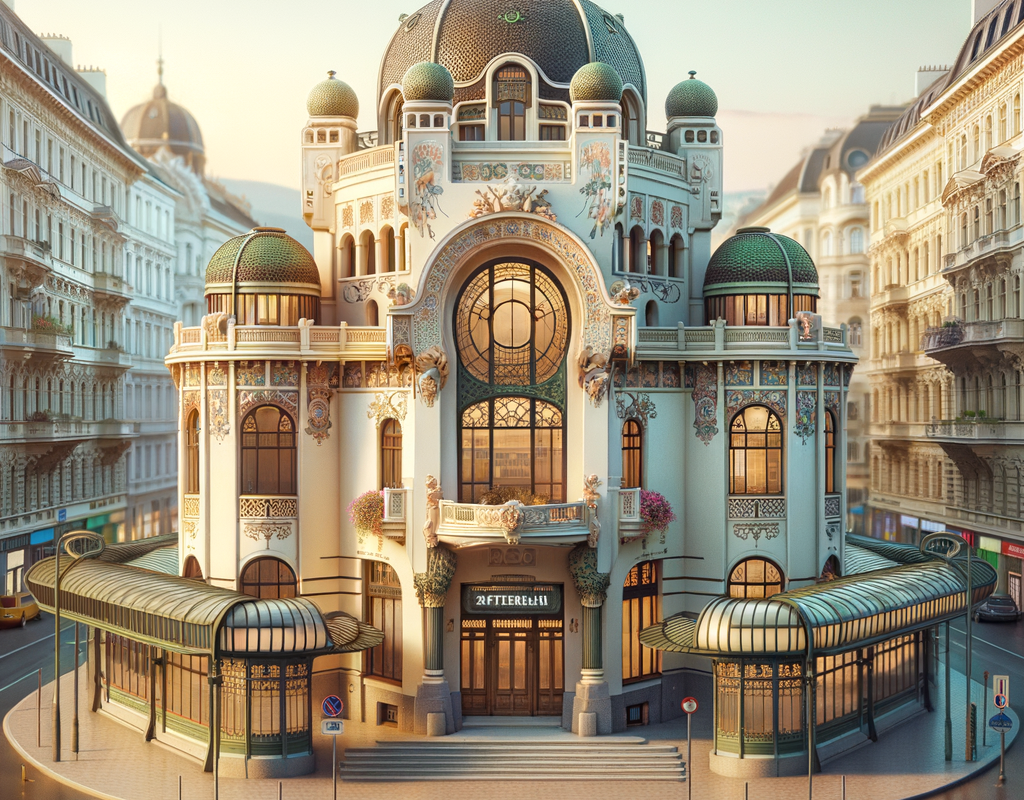
The twin pavilions at Karlsplatz are small but mighty: marble cladding, cast-iron frames, and gilded sunflower motifs set on a strict grid. They once served the city’s light-rail `Stadtbahn`, later adapted into today’s U-Bahn.
Design details to spot:
– Sunflower rosettes and leaf garlands with gold accents
– A crisp cornice line and round fanlights that echo train wheels
– Typography and signage integrated as part of the facade language
Some pavilion spaces host exhibitions; check on-site notices for current use.
Riding the legacy: U4 and U6 today
Many Stadtbahn stations were absorbed into U4 and U6. You’ll still find Wagner-era elements—platform canopies, iron supports, and tiled signage—especially at older stops.
– U4 traces the Wien River; stations near Hietzing and Schönbrunn carry the old DNA.
– The Hietzing Hofpavillon, built for the emperor, survives as a small museum with refined detail.
Tip: A standard 24-hour transit ticket often costs less than two single rides and gives freedom to hop between sites.
Where to find the gold—and how to photograph it
– Karlsplatz: Gilded sunflowers catch low-angle light at golden hour.
– Hietzing: Look for fine metalwork with regal monograms.
– A circular polarizer can tame glare on glazed tiles and glass.
– Common mistake: Shooting only head-on. Try diagonal angles to reveal depth and relief.
Best practices for respectful visits
– Stay behind safety lines on platforms.
– Follow posted photography rules; some interiors restrict tripods.
– Avoid crowding doors during commuter peaks (7:30–9:00 and 16:30–18:30).
Planning your Vienna Art Nouveau architecture route
A simple one-day itinerary (on foot and U-Bahn)
Morning (Secession + Naschmarkt)
– Start at the Secession Building when it opens. Spend 60–90 minutes.
– Walk the Naschmarkt edge toward Linke Wienzeile.
Late morning (Majolikahaus pair)
– Continue 10 minutes (about 700 meters) to Linke Wienzeile 38–40.
– Photograph both facades from across the market stalls.
Afternoon (Karlsplatz pavilions)
– Return to Karlsplatz on foot (12–15 minutes) or via U4 one stop.
– End with the pavilions and, time permitting, a ride on U4 to sample Wagner-era stations.
When to go for best light and fewer people
– Weekdays beat weekends for clear sidewalks and cleaner compositions.
– Spring and early autumn offer crisp light and milder temperatures.
– Golden hour flatters gilding; morning suits the Majolikahaus tiles.
Budgeting time and costs
– Secession admission is modest; confirm current prices on the official site.
– Transit day-pass gives flexibility and usually pays off if you ride 3+ times.
– Expect a full day including breaks; 5–7 hours feels unhurried.
Common mistakes to avoid
– Rushing: These facades reward slow looking; spend at least 10–15 minutes per building.
– Over-editing photos: Keep colors natural to honor material truth.
– Ignoring signage: Interiors and platforms can have strict rules.
Conclusion: See the city through a modern lens
Vienna’s `Jugendstil` is not just decoration. It’s a language of clarity, function, and stylized nature that changed how cities look and feel. By pairing the Secession Building’s manifesto, the Majolikahaus’s floral skin, and Wagner’s gold-laced transit pavilions, you’ll experience a movement that still guides great design today.
Ready to plan your walk? Use the route above, skim our related guides, and give yourself time to slow down and look. Share your favorite facade or pattern—and tell us what surprised you most about Vienna Art Nouveau architecture.
FAQ
Q: What’s the difference between `Jugendstil` and Art Nouveau?
A: They’re closely related. `Jugendstil` is the German-speaking variant of Art Nouveau, with a leaner, more geometric approach in Vienna.
Q: Can I see Klimt at the Secession?
A: Yes. The permanent highlight is Klimt’s Beethoven Frieze. Exhibitions change, so confirm opening times and access on the Secession’s official site.
Q: Is the Majolikahaus open to the public?
A: It’s a residential building. Enjoy the facade from the street and respect residents’ privacy; there’s no interior tour.
Q: Which U-Bahn lines show Otto Wagner’s design best?
A: Explore U4 and U6 for station elements from the old Stadtbahn—plus Karlsplatz and Hietzing pavilions—on your Vienna Art Nouveau architecture explorations.